






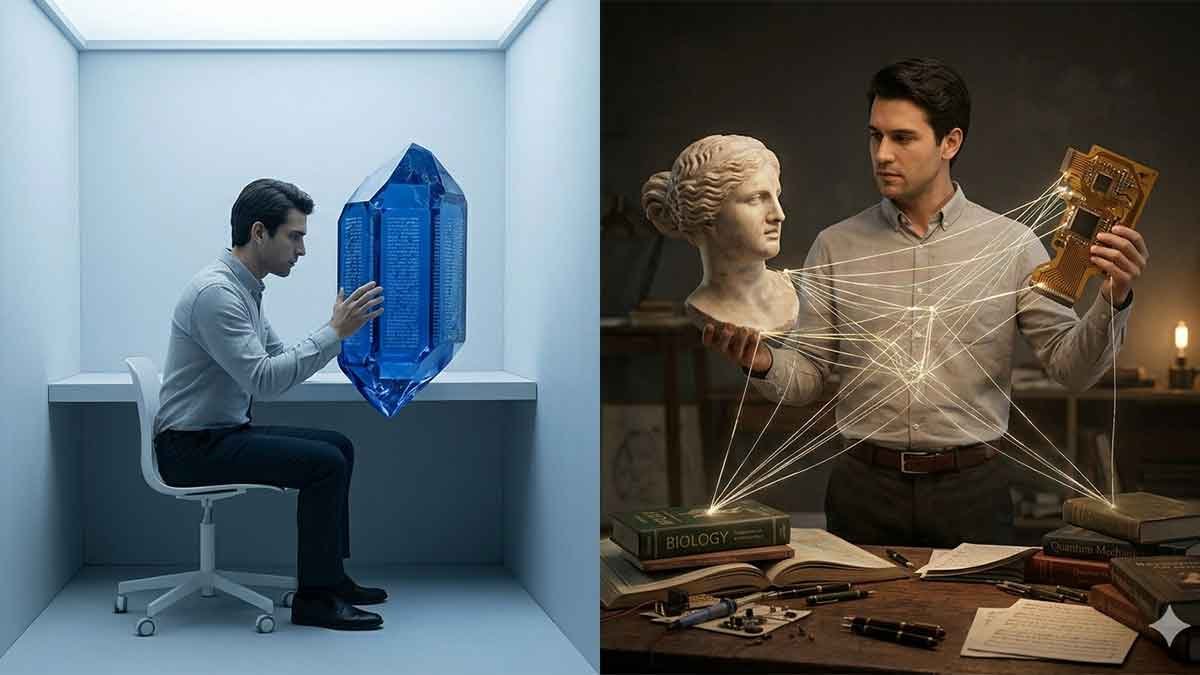
In a world that constantly tells us to “pick one thing and stick to it,” having multiple interests often feels like a weakness—but this idea is starting to change.
As explained by Great Ideas Great Life, people who explore different fields are not confused; they are building a powerful advantage. The article highlights how success doesn’t come in just one form.
Some people, like Sachin Tendulkar, achieve greatness through deep specialization, while others, like Ratan Tata, succeed by connecting ideas across industries and thinking broadly.
In today’s fast-changing world, where adaptability matters more than ever, those with multiple interests are quietly creating unique paths, solving problems creatively, and standing out in ways that specialists sometimes can’t.
Here is a summary of the key concepts discussed:
1. The Two Types of Brains
- Specialist Brain: Driven by importance, expectations, and deadlines. It focuses deeply on one thing (e.g., cricket).
- Multipotentialite Brain: This brain hits a “Hyper-Focus” state using the PINCH acronym:
- Passion: Excitement for the task.
- Interest: New topics or skills light up the brain.
- Novelty: High engagement during the early stages of learning.
- Challenge: Interest peaks when a task is difficult; easy tasks cause boredom.
- Hypersensitivity/Urgency: A feeling that the work must be done now.
2. Why We Focus on “The One Thing”
The idea that we must focus on just one thing didn’t come from nowhere—it can be traced back to the work of Adam Smith nearly 250 years ago. In his famous book The Wealth of Nations, he introduced the concept of the Division of Labor, using a simple pin factory as an example.
Smith showed that when workers each performed a small, repetitive task instead of making the entire product themselves, productivity increased dramatically—by as much as 240 times.
This idea was incredibly powerful during the Industrial Revolution, and it soon shaped not just factories but also how society thought about work and efficiency. Over time, this “factory mindset” made its way into education systems, where students were trained to follow instructions, specialize early, and fit into predefined roles, much like workers on an assembly line.
While this system created discipline and efficiency, it also quietly discouraged curiosity and creativity, making people believe that success only comes from doing one thing really well, even though today’s world often rewards those who can think across multiple areas.
Related Stories from SkillHub77
- Why Successful People Win the Day Before 11 AM – A Real Time Management Story
- My Journey to ₹10 Crore Net Worth: The Simple Investing Strategy That Worked
- The Roadmap to Your First ₹1 Crore: A Simple Plan Anyone Can Follow
- From ₹5,000 to ₹1 Crore: The Simple SIP Strategy Anyone Can Start Today
3. The Medici Effect
The idea of the “Medici Effect” shows that real innovation often happens when different fields come together rather than staying separate. Back in the 1400s, the powerful Medici family in Florence brought together artists, scientists, philosophers, and thinkers from many disciplines and encouraged them to interact, share ideas, and learn from one another.
This mixing of knowledge created an environment where creativity could thrive in unexpected ways. For example, the concept of 3D perspective in painting became possible when artists started learning geometry from mathematicians, allowing them to create depth and realism like never before.
Similarly, Leonardo da Vinci took art to another level by studying human anatomy in detail, combining his artistic skills with medical science to produce incredibly accurate and lifelike work.
These breakthroughs were not the result of sticking to one narrow field, but of exploring multiple interests and connecting them, proving that when different ideas collide, they often create something far more powerful than what any single discipline could achieve on its own.
4. Four Models to Manage Multiple Interests
To make the most of having multiple interests, the video explains that there isn’t just one “right” path—you can shape your career in different ways depending on your personality and situation.
One approach is the Group Hug model, where you bring all your interests into a single role or business, much like Farhan Akhtar, who blends acting, directing, music, and storytelling into one creative career.
Then there’s the Einstein Model, where you keep a stable 9-to-5 job for financial security while exploring your passions on the side, giving you both safety and freedom without pressure.
The Slash Model takes a more ambitious route, where you actively pursue multiple careers at the same time, fully committing energy to each path instead of treating them as hobbies.
Finally, the Phoenix Model is about going all in on one interest for a few years, mastering it deeply, and then completely reinventing yourself by moving to a new field—just like Arnold Schwarzenegger, who successfully transitioned from bodybuilding to acting and then into politics.
Each of these models shows that having multiple interests is not a weakness to fix, but a flexible advantage you can design your life around, depending on what works best for you.
The Final Thought
In the end, having multiple interests is not something to feel guilty about or try to “fix”—it’s something to understand and use wisely.
The world may still reward specialists in certain areas, but it is increasingly shaped by people who can connect ideas, adapt quickly, and think beyond one narrow path.
When you allow yourself to explore different interests, you build a unique perspective that no one else can easily copy, and that becomes your real strength over time.
The key is not to chase everything randomly, but to approach your interests with intention—choosing a path, committing to it, and knowing when to evolve.
Whether you combine your passions, balance them with stability, or move from one field to another, success comes from using your curiosity as a tool rather than seeing it as a distraction.
In a fast-changing world, the ability to learn, unlearn, and relearn across different areas may quietly become one of the most valuable skills you can have, even if it doesn’t always look impressive at first.
FAQs
1. Is having multiple interests a strength or a weakness?
Having multiple interests is actually a strength when managed well. It allows you to think creatively, adapt to change, and connect ideas from different fields. While it may feel confusing at times, this diversity can give you a unique edge in solving problems and finding opportunities.
2. Why do people say we should focus on only one thing?
This belief comes from older systems influenced by industrial thinking, where specialization increased efficiency. While focusing deeply on one skill can bring mastery, today’s world also values adaptability and broad thinking, which come from exploring multiple interests.
3. Can I succeed without choosing a single career path?
Yes, you can. Many people succeed by combining interests, managing side projects, or even switching careers over time. What matters most is consistency, learning, and applying your skills in meaningful ways rather than limiting yourself to just one path.
4. How do I manage multiple interests without feeling overwhelmed?
The key is to prioritize and structure your time. You don’t have to pursue everything at once. You can focus on one main area while slowly exploring others, or follow a model that suits your lifestyle, like balancing a stable job with side passions.
5. What if I keep losing interest and switching too often?
This is normal for curious people, but it’s important to stay long enough in one area to build real skills. Instead of quitting quickly, try setting a time frame (like a few months or years) to explore deeply before moving on.
6. Are generalists really successful in today’s world?
Yes, especially in a fast-changing environment. Generalists often bring fresh ideas by combining knowledge from different areas, making them valuable in innovation, leadership, and problem-solving roles.
7. How can I turn my multiple interests into a career?
You can either combine them into one unique role, pursue them side by side, or transition between them over time. The key is to find ways your interests can complement each other and create value for others.