







In this article, Pushkar Raj Thakur explains the powerful “7-3-2-1” rule of Systematic Investment Plan through a simple and relatable story about three friends who start investing at different stages of their lives.
The story shows how small, consistent investments made early can grow into a surprisingly large amount of wealth over time because of the magic of compound interest.
Instead of focusing on complicated financial strategies, the article highlights a basic but often ignored truth: time is the most powerful factor in investing.
By comparing the different outcomes of the three friends, Pushkar Raj Thakur makes it clear that starting early and staying consistent with SIP investments can make a huge difference in long-term wealth creation.
The explanation is simple, practical, and meant to help beginners understand how disciplined investing and patience can slowly turn small monthly contributions into significant financial security in the future.
1. The Story of Three Friends (Rahul, Yash, and Himanshu)
The article uses an example of three friends who all start an SIP of ₹5,000 per month at the age of 18, but get very different results based on their behavior:
- Rahul (The Disciplined Investor): He continues his SIP regardless of market crashes. After 12 years, his portfolio grows to over ₹32 Lakhs.
- Yash (The Panicked Investor): He stops his SIP and withdraws money when the market crashes by 25%. Because he was in high-risk Small Cap funds, he loses 50% of his capital and misses the recovery.
- Himanshu (The Market Timer): He gets scared and withdraws during the crash, then reinvests only after the market starts rising again. By doing this, he misses the most profitable growth periods.
2. The 7-3-2-1 Rule Explained
The rule describes how compounding accelerates over time:
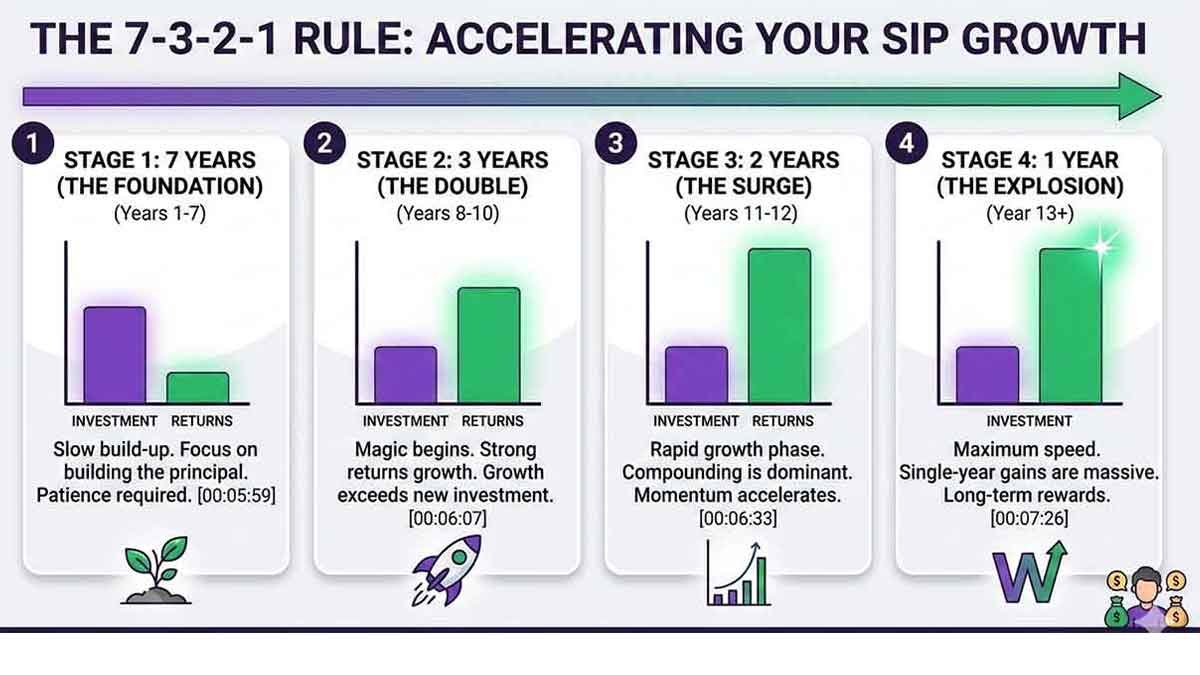
- 7 Years: It takes about 7 years to build a solid initial corpus. During this phase, your invested amount is usually higher than your returns.
- 3 Years: In just the next 3 years (total 10 years), that corpus almost doubles due to the base you’ve built.
- 2 Years: In the following 2 years (total 12 years), the wealth grows even faster, potentially reaching triple the initial 7-year mark.
- 1 Year: After year 12, the growth in a single year can often exceed the total growth of several previous years combined.
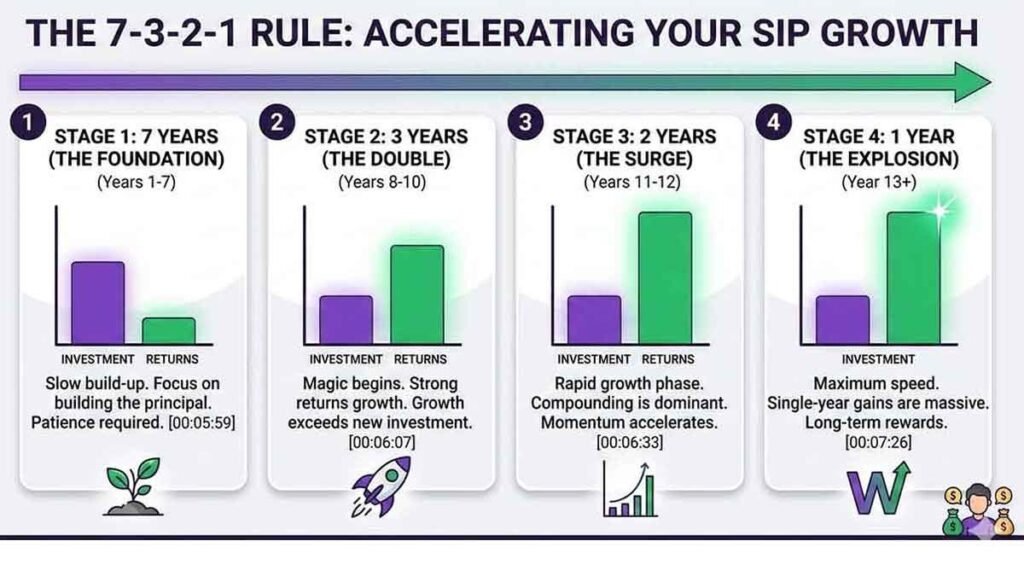
The 7-3-2-1 rule of investing explains how the power of compound interest slowly builds momentum and then begins to grow much faster with time. In the first seven years, the main goal is to build a strong base through consistent investments, usually through a Systematic Investment Plan.
During this early stage, many investors feel discouraged because most of the money in the account comes from their own contributions rather than from returns. It can feel like progress is slow, but this period is actually laying the foundation for future growth.
After those initial seven years, something interesting begins to happen. In the next three years, making it a total of ten years, the money often grows much faster because the accumulated amount has become large enough for compounding to work more effectively, and the corpus can nearly double.
Then in the following two years, reaching around twelve years of investing, the growth becomes even more noticeable and the wealth may reach around three times the value of what it was at the seven-year mark.
By the time an investor crosses the twelfth year, compounding starts showing its real strength, and sometimes the growth in just one single year can be greater than what was earned in several earlier years combined.
This rule simply highlights an important truth about long-term investing: the biggest rewards usually come to those who stay patient, keep investing regularly, and give compounding enough time to do its work.
3. Key Takeaways
- Consistency is King: The magic of SIP starts happening after the 8th year when your returns (the “green line”) finally overtake your total investment (the “purple line”).
- Don’t Stop During Crashes: Market dips are actually opportunities to buy more units. Stopping your SIP during a crash (like Yash did) guarantees a loss.
- Long-Term Vision: If Rahul continues his ₹5,000 SIP for 25 years, he could accumulate over ₹1.5 Crores.
One of the biggest lessons from long-term investing is that consistency matters more than timing the market. When someone invests regularly through a Systematic Investment Plan, the real magic usually begins after several years of patience. In many cases, around the eighth year, the returns generated by compound interest start becoming larger than the total money the investor has personally put in.
If you imagine a graph, the investment amount is like a steady purple line that grows with each monthly contribution, while the returns appear as a green line that starts slowly but eventually rises faster and crosses the investment line.
That moment is powerful because it means your money has begun working harder than you are contributing. Another important point is to never panic during market crashes. Many people stop their SIP when the market falls because they feel scared, but this is often a mistake.
Market dips actually allow investors to buy more mutual fund units at lower prices, which can increase long-term gains when the market recovers. Stopping investments during a crash locks in the fear and prevents you from benefiting from the eventual rebound.
A long-term perspective makes all the difference. For example, if someone like Rahul continues investing just ₹5,000 every month through SIP and stays disciplined for 25 years, the total wealth created could potentially grow to more than ₹1.5 crores, depending on market performance.
This simple example shows that wealth building is rarely about quick wins. Instead, it is about staying consistent, ignoring short-term market noise, and allowing time and compounding to quietly do their work.
The Final Thought
To build meaningful and long-lasting wealth, an investor needs to develop the same mindset as “Rahul” in the story, someone who stays disciplined with his investments and refuses to get distracted by short-term market movements.
Many people start investing with enthusiasm, but they lose patience when markets fluctuate or when they don’t see quick results. The real advantage, however, comes to those who remain consistent with their Systematic Investment Plan and allow time to do the heavy lifting.
The idea behind the compound interest and the 7-3-2-1 rule is simple: wealth grows slowly at first, but once the foundation is built, the growth begins to accelerate in ways that surprise most investors. Rahul’s approach shows that instead of reacting to every market dip or worrying about daily headlines, the smarter strategy is to stay focused on the long-term goal.
By continuing to invest regularly, even during uncertain times, an investor keeps adding to the base that compounding will later multiply. Over many years, this steady and patient approach can transform small monthly contributions into a surprisingly large financial corpus.
In the end, wealth creation is less about predicting the market and more about discipline, patience, and the willingness to stay invested long enough for the process to work.
FAQs
1. What is a Systematic Investment Plan (SIP)?
A Systematic Investment Plan is a simple way to invest money regularly in mutual funds. Instead of investing a large amount at once, an investor contributes a fixed amount every month or at regular intervals. This approach makes investing easier and more disciplined because it spreads investments over time and reduces the stress of trying to find the perfect moment to invest in the market.
2. What is the 7-3-2-1 rule in SIP investing?
The 7-3-2-1 rule explains how wealth grows faster over time due to compound interest. The idea is that the first seven years are mostly about building the base of your investment. In the next three years, the corpus may grow much faster and can nearly double. In the following two years, the growth can accelerate even more, and after around twelve years, the increase in just one year can sometimes be greater than the growth seen in several earlier years combined.
3. Why is consistency important in SIP investing?
Consistency is important because the real benefits of compounding appear only after several years. When you keep investing regularly without stopping, your investment base becomes larger, and your returns start generating their own returns. Over time, this process can significantly increase your wealth, even if the monthly investment amount is relatively small.
4. Should I stop my SIP during a market crash?
In most cases, stopping your SIP during a market crash is not a good idea. Market dips actually allow investors to buy more units of a mutual fund at lower prices. When the market eventually recovers, those extra units can increase the overall value of your investment. Staying invested during difficult market phases often benefits long-term investors.
5. How long should I continue a SIP to see meaningful results?
SIP investing works best when done for the long term. Many financial experts suggest staying invested for at least 10 to 15 years, or even longer if possible. The longer you remain invested, the more time compounding has to grow your money, which can lead to significant wealth creation over the years.